Chapter 3: They Called Her Confused
“That’s my number,” Claire said. “The bank needed someone they could reach.”
My mother looked up from the application.
“They could have reached me,” she said. “My telephone works.”
Claire’s hand left the back of my chair.
“It works now,” she replied.
I photographed the contact section, keeping the page flat so the bank’s name and my mother’s name appeared together.
Derek closed his folder.
“We’re finished with this for tonight,” he said.
He began collecting the loose sheets.
My mother put her hand on the borrower-information page.
“I’m still reading that,” she told him.
Derek slid another document out from underneath it.
“You’ve seen the relevant parts,” he said.
I stood.
“Leave what you showed us,” I told him.
“These are financial records,” Derek replied. “They shouldn’t be lying around in front of guests.”
He had chosen to bring them out in front of guests.
Now that my mother was reading them, they had become private.
I moved the photographed pages closer to her and picked up my phone.
Derek reached across the sideboard.
His fingers caught the edge of the phone case.
I pulled it toward my chest.
He followed.
“Give me that,” Derek said.
“No,” I replied.
He caught my wrist.
The movement was quick and hard enough to turn my hand outward.
I stepped back toward the open kitchen doorway and put my free forearm between us.
“Let go,” I told him.
Derek pressed forward.
My elbow struck the doorframe.
I felt anger come up through me so fast that, for one second, I wanted to push him clear across the room.
Instead, I planted my feet.
“Take your hand off me,” I said.
He released my wrist.
A serving spoon fell somewhere behind us.
Claire stepped between us with both palms raised.
“Nathan, stop,” she said.
Derek straightened his shirt.
He looked toward the remaining guests.
My mother stayed in her armchair.
“Derek grabbed his wrist,” she said.
Claire turned toward her.
“Please, Evelyn,” she replied. “You don’t need to get involved.”
My mother’s face changed.
Very little.
Enough.
“I am involved,” she said.
My pulse was pounding. I could feel the place where my elbow had hit the frame.
I checked the phone.
The photographs were still there.
Claire took her own phone from her apron pocket.
“You’re frightening her,” she told me.
“Ask her,” I replied.
Claire looked at my mother.
My mother answered before a question came.
“I’m frightened by the paperwork,” she said. “And I don’t want Derek touching my son.”
Derek picked up the leather folder.
“He came at me,” he said.
“I stood between you and my phone,” I replied.
My voice had become loud.
I heard it.
So did everybody else.
Claire began speaking into her phone.
“My husband is very upset,” she said. “There’s been a physical confrontation at a family dinner.”
She gave the address.
I stood still.
My wife was calling the police in the house where my father used to carve the turkey.
I could hear her giving the dispatcher an account of the previous thirty seconds.
Her brother had tried to calm things down.
Her husband had become aggressive.
An elderly woman was confused and distressed.
Each sentence made the room less recognizable.
My mother reached for her tea.
Her hand shook once against the cup.
Claire noticed.
“See?” she said, covering the phone.
I wanted to shout.
That would have given her exactly what she was describing.
I lowered my voice.
“Mom, would you like me to stay beside you?” I asked.
“Yes,” my mother replied. “Until the officer comes.”
I pulled my chair back beside hers.
Derek gathered the rest of his packet.
I kept the copies he had handed us.
Claire continued talking.
I sat down.
* * *
A little later, Claire told me the dispatcher wanted someone near the entrance.
I asked my mother whether she was comfortable waiting where she was.
“I’m staying here,” she said. “I have my papers.”
I put on my coat and went outside.
From the driveway, I could see her through the dining-room window.
She sat upright with the blue folder on her lap. Derek stood near the sideboard. Claire had moved between the kitchen and the front hall.
The streetlights were on.
I checked the time.
5:24.
My phone vibrated.
A message appeared in the family group Claire had created for holiday plans.
I opened it.
Claire had written that my mother had been experiencing cognitive changes.
That she and Derek had been helping manage things discreetly.
That I had returned unexpectedly and misunderstood a difficult situation.
Then came the sentence that made me stop breathing for a moment.
Please don’t call Evelyn directly tonight. Contradictory information makes her more confused.
Lily was in that group.
So was Martin.
So were relatives who had not been at dinner and had never seen the chair beside the trash can.
They would see this first.
I saved the message.
Then I looked through the window.
My mother was reading one of the pages.
Nobody was holding it for her.
Nobody was explaining where her name appeared.
The front door opened.
Claire walked down the steps with her phone in her hand.
“I needed people to understand what happened,” she said.
“You told them my mother has cognitive problems,” I replied.
“She forgets things,” Claire said.
“What diagnosis are you talking about?” I asked.
Claire tucked her phone into her apron.
“You haven’t been here for every appointment,” she replied.
She had used my absence to explain almost everything that afternoon.
Some of it was fair.
I had missed appointments.
I had missed ordinary afternoons.
I had let her send reports instead of making time to hear my mother’s voice.
But that did not make every claim Claire made true.
I held up my phone.
“You told people not to contact her,” I said.
“Tonight,” Claire replied. “I’m trying to keep her calm.”
“My mother can decide whether to answer a telephone,” I said.
Claire glanced toward the window.
“She needs support,” she replied.
“She asked for support,” I said. “She got a chair beside the garbage.”
Claire’s eyes filled.
I knew that face.
I had seen it after a failed business pitch, after an argument with Derek, after my father’s funeral.
Usually, I moved closer.
This time, I stayed where I was.
“I cooked for everyone,” she said.
“I know,” I replied.
“I spent days on this,” Claire said.
“I know that, too,” I replied.
She wiped beneath one eye.
“You’re making me sound cruel,” she said.
I looked back at the house.
My mother had turned toward the window.
She could see us.
“I’m going to let her tell the officer what happened,” I said.
Claire looked at me as though I had announced a betrayal.
Then she went inside.
I typed one message to Lily.
Grandma is speaking for herself. I’m with her. Please don’t draw conclusions from the group message.
I did not ask my daughter to choose a side.
I had no right to turn her into another person responsible for sorting out what I should have noticed.
Headlights appeared at the end of the street.
I put my phone away.
* * *
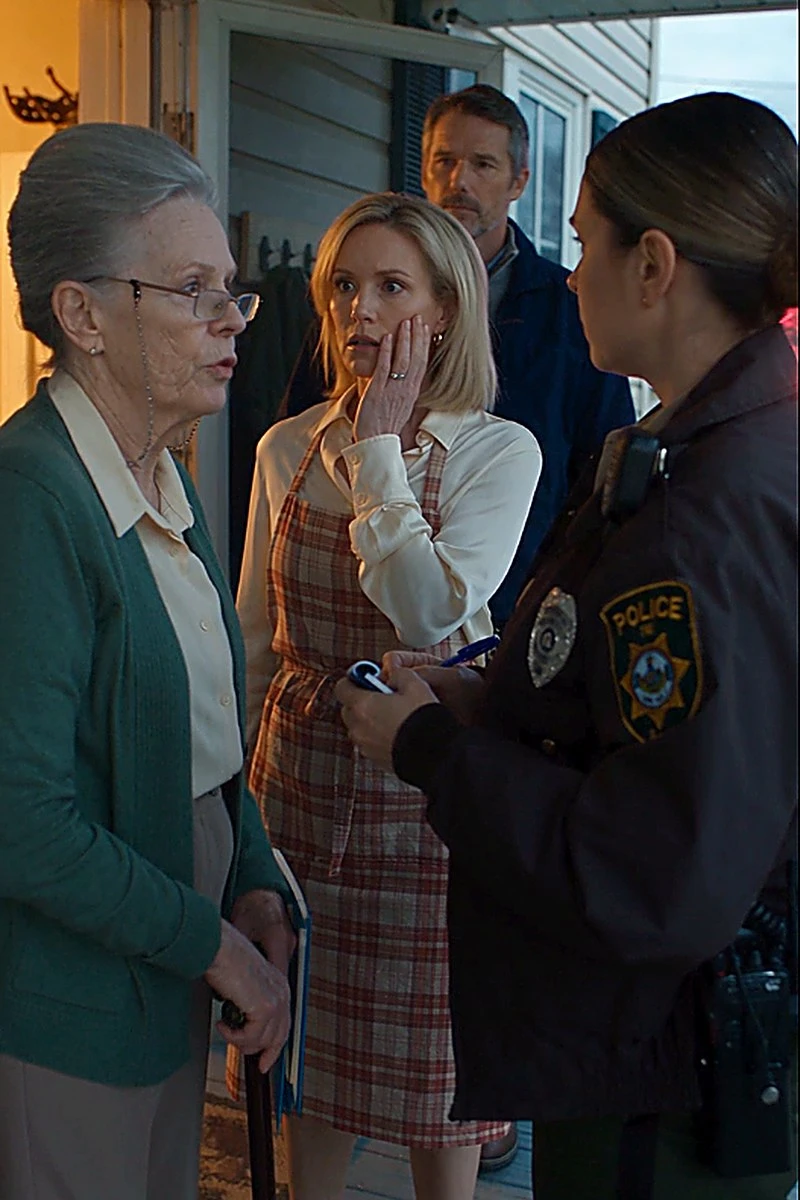
The officer asked me to stay on the porch while her partner went inside.
I explained the struggle over the phone.
I showed her the photographs.
Then I told her which part I had witnessed myself and which part my mother had told me.
She wrote that distinction down.
“Did you strike him?” the officer asked.
“No,” I replied. “I blocked him with my arm after he took hold of my wrist.”
“Any injuries?” she asked.
“My elbow hit the frame,” I replied. “I don’t need medical attention.”
The officer looked through the front doorway.
Her partner was speaking to Derek near the stairs.
Claire stood a few feet away, answering questions that had not been directed at her.
The officer turned back to me.
“I need to speak with your mother separately,” she said.
“I understand,” I replied.
My mother came to the doorway with her cane and the blue folder.
The officer offered to speak inside.
“The porch is fine for a few minutes,” my mother said. “Nathan can stand over there.”
She pointed toward the far end.
I moved.
Through the open doorway, I could hear Claire telling the other officer about the surgery.
The knee.
The appointments.
The difficulty of getting my mother to accept help.
My mother waited until the officer in front of her had finished writing.
“I did not sign a financial power of attorney appointing Claire,” she said. “I did not ask Derek to redirect my mail. I have just seen a loan application involving my house.”
The officer asked whether she had authorized somebody else to sign for her.
“No,” my mother replied.
She said it without looking toward me.
The officer asked who lived in the house.
“I do,” my mother said. “My husband died in 2023.”
“Does your daughter-in-law live here?” the officer asked.
“No,” my mother replied. “She has a key for helping with errands.”
Claire appeared in the doorway.
“Evelyn, we discussed the forms after your surgery,” she said.
The officer raised a hand.
“I’m speaking with her right now,” she told Claire.
Claire stopped.
My mother’s shoulders lowered a little.
It was the first time that evening somebody with authority had stopped an answer from being placed in her mouth.
“I would like this documented,” my mother said. “The papers and what happened when Nathan tried to keep the copies.”
The officer nodded.
“I can take a report and include the information you provide,” she said. “Someone may contact you for additional records.”
My mother opened her folder and took out a blank sheet.
She wrote down the telephone number of the house.
“Use this number,” she told the officer. “It works.”
The officer accepted the page.
She did not declare my mother competent.
She did not declare Claire guilty.
She listened, took notes, and made sure she understood whose account she was recording.
That was enough to change the porch.
When she invited me back over, my mother gave permission for me to provide the photographs.
I sent them through the method the officer specified.
She wrote an incident reference on a card and handed it to my mother.
“This doesn’t determine whether the documents are valid,” the officer said. “Contact the bank directly about the loan.”
“I intend to,” my mother replied.
After the officers finished their separate conversations, they told everyone to keep their distance from one another.
They stayed a few more minutes while the room settled.
I brought my mother a coat.
She put it on herself.
Then I searched for Buckeye Community Bank’s official contact information.
I used the bank’s own website, not a number from Derek’s papers.
The regular lending department was closed for Thanksgiving.
The security line answered.
I explained that my mother was beside me and wanted to report suspected unauthorized lending documents.
The representative asked to speak with her.
I passed over the phone.
“My name is Evelyn Mercer,” my mother said. “I’m calling about a loan application in my name that I did not authorize.”
She completed the identity questions herself.
I stood beside the porch rail and waited.
When the representative asked whether anyone else was listening, my mother identified me.
“He may help me read the paperwork,” she said. “I’m making the report.”
She put the call on speaker.
The representative asked for the application reference printed on the page.
My mother read it.
Keys tapped at the other end.
“I’m recording this as a disputed-authority matter and sending an urgent alert to the lending review team,” the representative said.
“Does that stop anything from going out?” I asked.
“I can flag the transaction for review,” the representative replied. “I cannot confirm the full lending status from this desk.”
I wanted a stronger answer.
A promise.
A person saying that my mother’s house was safe.
The representative did not give us one.
She gave my mother a case reference and explained that the specialist team would follow up when it reopened.
“Keep the documents you have,” she said. “Please preserve any messages relating to the authority being claimed.”
I looked at Claire’s family update on my screen.
“We will,” I replied.
My mother asked the representative to use the restored house telephone for contact.
The representative confirmed it.
When the call ended, my mother stayed on the porch for a moment.
A car passed.
Someone’s kitchen window glowed across the street.
I held the door open.
“There’s one more thing we should check,” my mother said.
* * *
We went into the den.
It was the room where my father used to watch baseball with the sound too loud.
His recliner still faced the television. The remote sat in a ceramic bowl beside a pair of reading glasses my mother had never moved.
I brought my laptop from my suitcase.
My mother chose the straight-backed chair near the desk.
“The house records,” she said. “Look at what’s been put in the house records.”
I opened the Franklin County Recorder’s official site.
There was a link to search recorded documents.
I clicked it.
From the dining room, I heard a chair scrape.
The police had not ended the party.
They had left behind a quieter version of it.
People spoke in lowered voices. A few guests collected coats. Someone thanked Claire for dinner as though the evening had been merely awkward.
I entered my mother’s name.
The search returned several entries.
Some were old.
I recognized the year we had replaced the roof because Dad had talked about it for months.
My mother leaned toward the screen.
“Use the most recent first,” she said.
I changed the order.
Two entries appeared with dates from that week.
Tuesday.
November 25.
I checked the name.
Evelyn Anne Mercer.
The property reference matched the one on the lender paperwork.
My mother pulled the blue folder closer to her.
Claire came to the doorway.
“What are you doing now?” she asked.
“Looking at public records,” I replied.
“Derek already has copies of everything,” Claire said.
“I want to see the county’s copies,” my mother replied.
Claire looked at the laptop.
For the first time since I had arrived, she seemed unsure where to stand.
Derek appeared behind her.
“You won’t get the context from a search page,” he said.
“I’ll start with the page,” I replied.
I opened the first recent entry.
The document viewer took a few seconds to load.
The heading appeared.
Power of attorney.
My mother’s name.
Claire’s name.
The same October date inside the document.
But the county’s recording date was Tuesday.
I felt my mouth go dry.
The paper Derek had brought upstairs had seemed like something the family was supposed to discuss.
This copy had already passed beyond the family.
It had a recording stamp.
A document number.
A place in the public record.
I saved the displayed copy.
Derek moved closer.
“We should talk before you make assumptions,” he said.
My mother turned toward him.
“Stand back,” she told him.
He stopped behind the doorway.
I returned to the results and opened the second entry.
There was a delay.
A gray page filled the viewer.
I clicked once more.
The image sharpened.
I saw my mother’s name again.
Then the property description.
Then the county’s stamp.
The date was the same Tuesday.
I looked from the screen to my mother.
She had been sitting beside the trash can while guests toasted the house and Derek waited to explain arrangements.
All that time, I had been treating the papers as something we could refuse before they became real.
I read the document type.
Then I checked the recording stamp again.
The mortgage had already been recorded against her house.