Chapter 4: The Name on the Deed
“Recorded on Tuesday,” I said.
My mother leaned toward the screen.
The county’s stamp sat above her name. Farther down, Claire’s name appeared beside the words attorney-in-fact.
Derek stood in the doorway.
“Recording is a standard part of the process,” he said.
My mother looked at him.
“A process I did not authorize,” she replied.
I saved the document and the page showing when it had entered the county record.
My hands felt clumsy on the keyboard.
The bank’s security representative had taken a report. The police had taken a report.
Meanwhile, something had already been attached to my mother’s house.
“How did this happen without anybody speaking to her?” I asked.
Claire stepped into the den.
“People did speak to her,” she said. “You weren’t here.”
I stood so abruptly that the desk chair rolled backward.
“Everybody needs to leave,” I said.
My mother put a hand on my sleeve.
“Wait,” she told me.
I looked down at her.
“We can get them out,” I said. “Then we can deal with this.”
“I want to speak first,” she replied.
Claire folded her arms.
“Evelyn, there’s nothing to be gained by upsetting everyone,” she said.
My mother lifted the blue folder.
“They’ve heard your account,” she replied. “They can hear mine.”
I wanted to argue.
There were people downstairs who had watched her eat beside the garbage. I wanted to send them into the street carrying their coats and their shame.
That would have satisfied something in me.
My mother wanted something else.
I sat down again.
“What do you need?” I asked.
“A clear place at the table,” she said. “And my glasses.”
Her reading glasses were inside the folder.
She took them out herself.
Claire turned toward Derek.
He made a small movement with his head.
It could have meant wait.
It could have meant let her talk.
I had spent years missing exchanges like that because I assumed there was nothing to see.
My mother stood.
I offered my arm. She accepted it while she found her balance, then let go.
Claire moved toward the hallway.
“I’ll tell people we’re having a family discussion,” she said.
“No,” my mother replied. “Tell them I want to speak in my dining room.”
Claire stopped.
My mother walked past her.
Before following, I called the number the officer had provided for follow-up and gave the incident reference.
I explained that my mother was asking visitors to leave after speaking to them, that there had already been a physical confrontation, and that I wanted to avoid another one.
The dispatcher said an officer would return when available.
I closed the laptop.
On its dark screen, I saw my own face.
I looked older than I had that morning.
In the hallway, my mother waited beside the stairs.
“You don’t have to make a speech for me,” she said.
“I wasn’t going to,” I replied.
She studied me.
I had been preparing several.
“I’ll listen,” I said.
She nodded once.
Then she went toward the table.
* * *
Claire had cleared most of the dinner plates.
The serving dishes remained, surrounded by spoons, crumpled napkins, and little rings of spilled wine.
Several guests had already gone.
The others stood or sat in loose groups, uncertain whether to finish dessert or reach for their coats.
My mother stopped beside the chair at the end of the table.
The chair Claire had used.
Claire looked at it, then at her.
“I was sitting there,” Claire said.
“I know,” my mother replied.
Claire moved her purse.
I pulled the chair out, but waited for my mother to sit before doing anything else.
She placed the blue folder on the table.
Martin stood near the window with his hands in his pockets.
Derek stayed by the sideboard.
My mother put on her glasses.
“I want to clear up something about this house,” she said.
A woman in a burgundy sweater lowered her coffee cup.
Claire gave a tight smile.
“Nobody has disputed that you live here,” she said.
My mother opened the folder.
“I’m speaking about ownership,” she replied.
She took out a document with a county recording mark on its first page.
The paper had been folded once and flattened again. Its edges were softer than the pages Derek had brought.
“This deed was recorded on April 17, 2017,” my mother said.
She held it where the people nearest her could see.
Then she read.
“Walter J. Mercer and Evelyn Anne Mercer, husband and wife,” she said.
My father’s name made me look at the empty space beside the china cabinet.
He used to stand there when he carved.
My mother continued through the language describing the transfer.
Then she reached the name receiving the property.
“Evelyn Anne Mercer,” she read.
She lowered the page.
“That is the grantee,” my mother said. “That is me.”
Derek shifted his weight.
“The financial documents don’t change the ownership,” he said.
My mother looked at him.
“Then you should have had no difficulty remembering whose permission you needed,” she replied.
Claire placed both hands on the table.
“Walter wanted this house kept in the family,” she said. “He talked about that many times.”
My mother removed her glasses.
“Walter wanted me secure,” she replied. “He signed this with me.”
Claire looked toward Martin.
Martin stayed by the window.
“We all understood this would eventually be Nathan’s,” Claire said.
I stared at my wife.
Eventually.
She had said it as though my mother were a delay in a transaction.
My mother put her glasses back on.
“What happens eventually is a decision I get to make,” she said. “Today, I live here.”
Claire drew back.
“That isn’t what I meant,” she replied.
“Then listen to what I mean,” my mother said.
She laid the deed flat.
“I needed rides after surgery,” she continued. “I needed help bringing groceries inside. I did not give my house to anyone.”
Nobody interrupted.
My mother rested her fingertips beside her printed name.
“I did not agree to sit beside the trash can today,” she said. “I did not ask to be separated from my guests. And I did not ask anyone to describe me as confused.”
The woman in the burgundy sweater put down her cup.
“Evelyn, I thought you wanted somewhere quieter,” she said.
“You could have asked me,” my mother replied.
The woman nodded.
“I should have,” she said.
A man near the middle of the table looked at his empty plate.
Other people did the same.
It was strange how quickly a table could become something people wanted to examine.
The grain of the wood.
A stain on a napkin.
Anything that spared them from looking at the woman speaking.
Claire pulled a chair out.
“Managing this property is a lot for one person,” she said. “You’ve had difficulty with the stairs. There are repairs you keep putting off.”
“My knee is healing,” my mother replied. “The porch rail needs fixing. Those facts do not give you authority over my finances.”
Claire sat.
She looked smaller sitting below my mother’s line of sight.
I wondered whether that was how my mother had felt all afternoon.
Derek opened his mouth.
My mother raised a hand.
“I have already heard that you handle paperwork,” she told him. “Tonight, I saw paperwork with my name on it that I did not approve.”
Derek closed his mouth again.
My mother looked at me.
I felt the attention of the room move with her.
“I have called this my father’s house,” I said.
My voice sounded rough.
I glanced at the deed.
“I called it that when I came in today. I’ve called it that since he died.”
My mother waited.
“It was how I thought about him,” I continued. “But I let that become how I thought about you living here.”
Claire started to speak.
I looked at her.
“Let me finish,” I said.
She stopped.
“I should have asked Mom directly about the appointments,” I continued. “The bills. Whether she wanted visitors. I let updates from someone else replace conversations with her.”
Martin looked toward the floor.
I wanted to tell the room that my absence had not caused the cold plate.
That I had been working.
That I had loved my mother all along.
All of those things could be true while the woman at the table still had reason not to trust my attention.
“I missed things I should have noticed,” I said.
My mother folded her glasses.
“Then notice them now,” she replied.
I nodded.
She put the deed back in the blue folder.
“This document does not settle what the bank has recorded,” my mother said. “We still have to deal with that.”
Derek leaned forward.
“Exactly,” he replied. “That’s why we should sit down calmly and—”
“We have sat down,” my mother interrupted. “I have been calm.”
She closed the folder.
“Claire and Derek, I want you to leave,” she said.
Claire stared at her.
The room seemed to hold its breath.
Then my mother added one more sentence.
“And I want my house key back.”
* * *
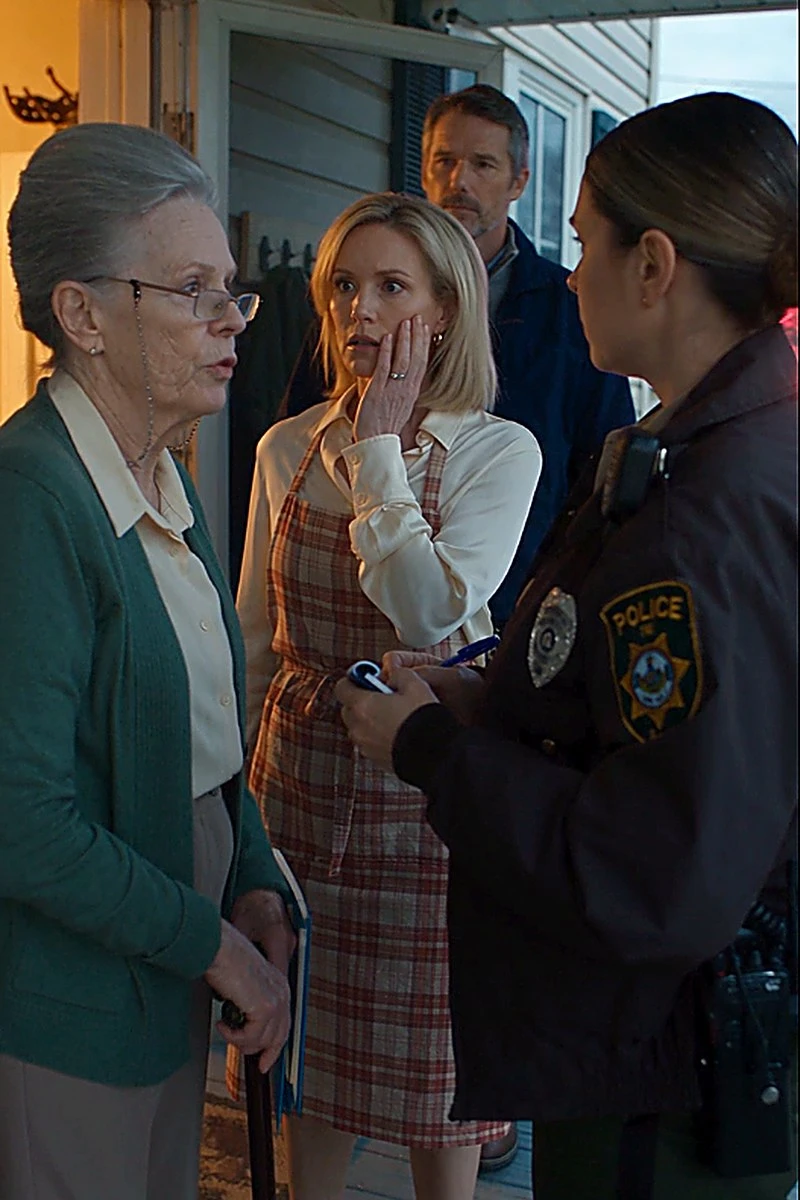
The returning officer arrived while the remaining guests were putting on their coats.
I stood beside the front door and let her in.
She was the same officer who had spoken with my mother on the porch.
My mother came into the hall.
“I have asked Claire and Derek to leave,” she told the officer. “They do not live here. I want their visits to stop.”
The officer looked at Claire.
“Is there any disagreement about who resides here?” she asked.
“No,” Claire replied. “We’re family.”
“Mrs. Mercer has asked you to leave tonight,” the officer said.
Claire looked at me.
I knew what she wanted.
A correction.
A softer version.
Something about everybody being tired.
I stayed beside my mother.
Claire took a coat from the hook and pushed one arm into it.
“You’re letting her do this,” she told me.
“She has asked you to leave her home,” I replied.
Claire pulled on the other sleeve.
My mother held out her hand.
“The key,” she said.
Claire reached into her purse.
She took out a ring with three keys and began turning them around the metal circle.
The brass one caught against another key.
She tugged harder.
I remembered handing her the spare after my mother’s surgery.
I had told Claire it would make everything easier.
I had meant groceries and rides.
Claire worked the brass key free and dropped it into my mother’s palm.
The tiny notch my father had filed into it faced upward.
My mother closed her fingers.
“Have any copies been made?” she asked.
“I haven’t made one,” Claire replied.
My mother looked at Derek.
“No,” he said.
She put the key in her cardigan pocket.
“I will be changing the locks,” my mother told them.
Claire gave a short laugh.
“You don’t need to turn this into a siege,” she said.
My mother did not answer.
Derek carried his leather folder under his arm.
My mother pointed at it.
“I want the lender copies that belong to me,” she said.
Derek stopped beside the doorway.
“You already have the relevant information,” he replied.
“I want my copies,” my mother repeated.
The officer watched them.
She did not reach for the folder or pretend she could decide the document dispute at the threshold.
Derek looked at Claire.
Then he opened the folder.
He removed a thick white envelope and held it out.
My mother’s name was printed on the front beneath the bank’s logo.
“These explain the complete arrangement,” Derek said.
My mother accepted the envelope.
“I will read them,” she replied.
Derek closed the folder.
Several people were waiting on the porch.
They had stopped talking.
Claire walked past me, then turned back.
“We still have a home together,” she said quietly.
“I know,” I replied.
“You need to think about what you’re doing,” Claire told me.
I looked at the bank envelope in my mother’s hands.
“I’ve started,” I said.
Claire went down the steps.
Derek followed.
The officer remained until their car pulled away.
Martin was the last guest in the hall.
He looked at my mother.
“If you need anything, Evelyn, call me,” he said.
My mother nodded without making a promise.
Martin put on his coat.
When he left, I closed the door.
The officer gave my mother a few practical reminders about preserving the documents and following up with the bank.
My mother thanked her.
Then the officer left, too.
The house became quiet.
For the first time that evening, nobody was telling my mother what she had meant.
* * *
We went back to the kitchen.
My mother placed the bank envelope beside the blue folder.
I filled the kettle.
She sat at the breakfast counter, in the same place where she had finally eaten a hot dinner.
There were dishes everywhere.
Claire had left a roasting pan soaking in the sink. A dessert plate with a half-eaten slice of pie sat beside it.
I began stacking the plates.
“Those can wait,” my mother said.
I stopped.
She opened the envelope.
Inside was a packet held together with two large clips.
The top page identified her as the borrower.
Underneath were documents dated November 25.
Tuesday.
I had spent that day inside a plant with ear protection on, helping restart a line after an equipment installation.
At lunch, I had sent Claire a picture of a vending-machine sandwich.
She had replied with a heart.
My mother turned the first page.
Claire’s signature appeared in the space for the person acting under the purported power of attorney.
My mother touched the edge of the sheet.
“She signed her own name,” she said. “Under mine.”
I sat beside her.
“We’ll show the bank everything tomorrow,” I said.
My mother nodded.
The kettle began to hiss.
I got up, poured the water, and set a mug beside her.
As I passed the trash can, I looked at the folding chair.
It was still open.
I gripped its back.
“Leave it for now,” my mother told me.
I released it.
She watched me return to the counter.
“I don’t need every reminder removed tonight,” she said. “I need to understand these papers.”
I pulled my stool closer.
She handed me a section dealing with the loan’s completion.
There was language about a cancellation period.
A separate notice described when proceeds would become available.
I read it once.
Then I went back to the date at the top.
My mother took off her glasses and rubbed the bridge of her nose.
“I thought we were looking at something they wanted to do,” she said.
“So did I,” I replied.
The bank representative had accepted the dispute.
That was real.
The case reference was written on the paper beside my mother’s mug.
But the representative had not confirmed the lending status or promised that nothing could leave the account.
I picked up the notice again.
There was a scheduled disbursement date.
December 1, 2025.
I checked the calendar on my phone.
Monday.
My mother looked at me.
“How much time do we have?” she asked.
I kept my eyes on the page.
Below the date was the amount scheduled for release.
I followed the line across, making certain I had read the right figure.
Then I read it again.
The bank was scheduled to release $240,000 on Monday.