Chapter 3: Before I Knew
Seven weeks.
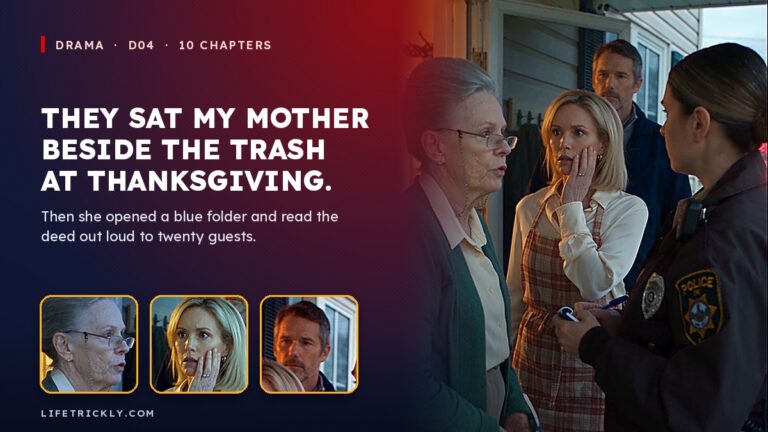
I held the phone out to Officer Nolan.
“That’s the same card,” I said. “The photograph was taken seven weeks ago.”
Nolan looked at the screen without taking it.
“Who sent this?” he asked.
“Talia Reed,” I said. “She’s still on the phone. She’s the school counselor.”
“Ask whether I can speak with her,” Nolan said.
I raised the phone.
“Talia, the officer is here,” I said. “Can I give him the phone?”
“Yes,” Talia replied. “I have the original record ready.”
Nolan took it and moved a few feet down the corridor.
I could still see June through the doorway.
She had set the blue house beside her cup. Micah was wearing the green shirt.
They looked like children waiting for an ordinary appointment.
Nolan wrote on a page supported against the wall.
Then he returned my phone.
“She’s preserving the records,” he said. “An investigator will follow up with her.”
“Did she tell someone before today?” I asked.
“She made a safeguarding referral,” Nolan said. “We’ll establish what was reported and what happened afterward.”
“So there was a warning,” I said.
“There was information that needs to be reviewed,” Nolan replied. “I don’t want to guess from one photograph.”
I looked at the date again.
Celeste had described a routine.
June had carried a paper saying I approved.
Those things had existed while I was answering work emails and asking whether we needed milk.
“Who’s reviewing it?” I asked.
“Detective Bell is taking the investigation,” Nolan said. “He’ll speak with you.”
“Tonight?” I asked.
“As soon as he can,” Nolan replied.
Inside the room, Cora lifted the empty cracker wrapper.
“Ethan?” Cora called. “Dana’s bringing the doctor.”
I put my phone in my pocket.
Nolan held up the envelope containing the card.
“I’ll make sure this travels through the evidence process,” he said. “Keep the message Talia sent you.”
“I will,” I said.
He walked toward the desk.
I went back to my children.
Dr. Banks pulled a chair toward the table instead of standing over us.
“I’m the pediatrician,” she said. “Dana has given me the intake information.”
June pulled the blue house closer.
“You can keep that,” Dr. Banks told her. “I’ll explain what I’m doing before I do anything.”
“Can Dad stay?” June asked.
“Yes,” Dr. Banks said.
Dr. Banks asked simple questions about food, sleep, and how they felt.
I answered only the questions directed at me.
When Micah looked at June before speaking, Dr. Banks waited.
He eventually pointed to his water.
“Could I have more?” Micah asked.
“Dana can get you more,” Dr. Banks said.
June reached for his cup.
“I’ve got it,” Dana told her.
June left her hand on the table.
The assessment took time.
I kept my voice level and moved when Dr. Banks needed space. I didn’t ask the children to explain the laundry room again.
Afterward, Cora sat with them while Dr. Banks spoke to me just outside the door.
“They need care and a stable setting,” Dr. Banks said. “We’re coordinating that with the safeguarding team.”
“Are you saying they’re okay?” I asked.
“I’m saying we’ve assessed their immediate medical needs,” Dr. Banks replied. “That isn’t the same as saying nothing happened.”
I pressed my thumb against my wedding ring.
“Celeste said I frightened them by coming home angry,” I said.
“We document what we observe and what we’re told,” Dr. Banks said. “We don’t settle the investigation from an adult’s explanation.”
“What happens tonight?” I asked.
“They’ll remain here while we complete the plan,” Dr. Banks said. “You’ll know who is responsible for them.”
“Do they have to tell anyone else everything tonight?” I asked.
“The specialist team will arrange appropriate interviews,” Dr. Banks replied. “Their care doesn’t depend on giving a complete account right now.”
My phone vibrated.
Celeste’s name appeared.
I let the call stop.
A message followed.
Please answer. One bad afternoon should not decide our children’s lives.
I turned the screen toward Dr. Banks.
“That’s what she’s calling it now,” I said.
“Keep the message,” Dr. Banks told me.
Dana came out carrying a fresh cup.
“June wants to know whether her dad is coming back in,” Dana said.
I put the phone away.
“Right now,” I told her.
Before I reached my chair, June moved the blue house into the place where my hand had been.
I sat down beside it.
* * *
The next morning, a woman named Laura Finch met us outside a room with a low table and two chairs.
“I conduct specialist child interviews,” Laura told me. “June and Micah will speak with me separately.”
Cora held the bag of clean clothes.
June held my hand.
“Can I tell her what we already know?” I asked Laura.
“You can give the adults your information separately,” Laura said. “For their interviews, I need their own words.”
“What if June thinks she needs to get everything right?” I asked.
“I’ll tell her she can correct me, say she doesn’t know, or ask for a break,” Laura replied.
June looked through the doorway.
“Where will Dad be?” June asked.
Laura pointed to a chair directly across the hall.
“He’ll wait there,” Laura told her. “You’ll know where he is.”
June looked at the chair.
I sat in it.
“Here,” I told her.
June handed the blue house to Micah.
“Hold this,” she said.
Micah closed both hands around it.
Laura stepped aside so June could enter.
The door closed gently.
I started to stand.
Cora put her bag on the chair beside me.
“Sit with me,” Cora said.
“I just want to see whether she’s settled,” I replied.
“Laura knows you’re here,” Cora said. “June saw where you sat.”
I sat down.
A cart rolled past. Someone answered a desk phone farther along the hall.
I watched the handle.
My daughter was speaking in a room where I couldn’t hear her.
I had no right to fill that silence with the answers I wanted.
Cora offered me water.
I took it without opening it.
When June came out, I stood.
Laura stayed beside her.
June looked at my face.
“Was it right?” June asked me.
“You don’t have to get anything right for me,” I told her.
Laura crouched slightly beside June.
“You told me what you remembered,” Laura said. “Thank you.”
June reached for the house.
Micah gave it back.
For his interview, he asked Cora to hold his water and me to stay in the same chair.
“I’ll stay here,” I told him.
He checked once from the doorway.
Then he went inside.
Later, Laura spoke with me away from the children.
“Both accounts describe more than today’s discovery,” she said. “The details will be documented and reviewed with the other evidence.”
“More than one afternoon,” I said.
“Yes,” Laura replied.
“How long?” I asked.
“Children don’t always organize time by calendar dates,” Laura said. “We’ll compare what they described with records. You shouldn’t try to get a date from them yourself.”
I looked toward the waiting area.
June was helping Micah straighten his shirt collar.
“I won’t,” I told Laura.
“What should I say when they ask whether they did it right?” I asked.
“Tell them they can speak honestly and don’t need to protect an adult’s feelings,” Laura said. “Then let the conversation move on if they want it to.”
“I keep wanting to check,” I admitted.
“Give that need to us,” Laura replied. “Let us check the records.”
She handed me the contact information for the coordinating team.
I folded it once.
Then I stopped.
The children’s card had been folded until its edges went soft.
I left this paper flat.
* * *
Detective Andre Bell met me in a small consultation room that afternoon.
Talia sat beside him with a folder closed beneath her hands.
Bell stood when I entered.
“Mr. Shaw,” he said. “I’m Andre Bell.”
“Ethan,” I told him.
Talia slid her chair back.
“I’m glad they’re receiving care,” she said.
I stayed standing.
“You had that card seven weeks ago,” I said.
“I photographed it seven weeks ago,” Talia replied. “June kept the card.”
“What did she say?” I asked.
Talia opened the folder.
“I recorded her words that day,” she said. “I won’t replace them with what I think they meant now.”
She turned a page toward Bell.
“June asked whether finishing meant she could stop being quiet,” Talia said. “She showed me the card when I asked what she meant.”
My hand tightened around the chair back.
“Did she say laundry room?” I asked.
“She mentioned the sheets,” Talia said. “She also asked whether I could tell you she had finished.”
I pulled the chair out and sat.
“What did you do?” I asked.
“I followed our safeguarding process and made a referral,” Talia said. “I preserved the card photograph and my notes.”
“And then?” I asked.
“Her mother described it as a family calming routine,” Talia replied. “The information available then didn’t establish the full arrangement. I continued documenting concerns.”
Bell kept his pen still.
Talia placed a second page beside the first.
“Two weeks later, June asked to remain in my office when the classroom was labeling project folders,” Talia said. “I recorded the context and her words. I followed up on the referral.”
She added a third page.
“This was a drawing she made during a later check-in,” Talia said.
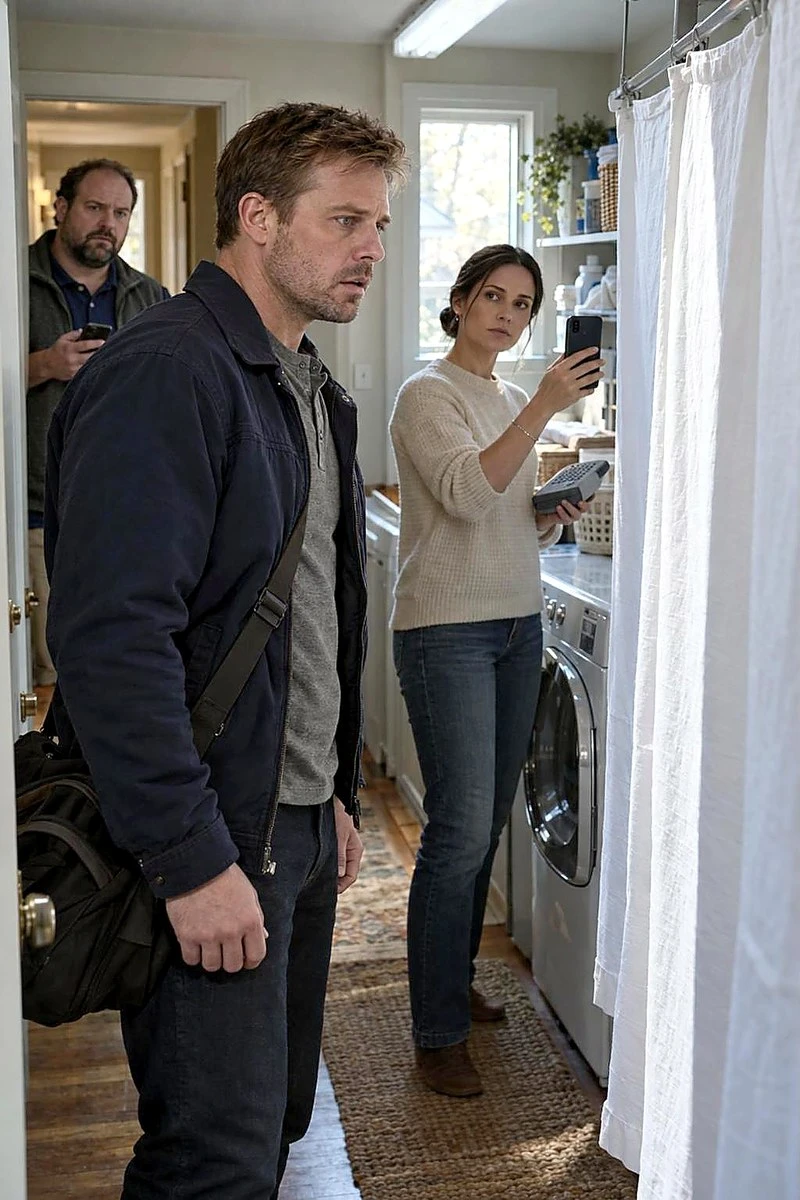
The picture showed two tall hanging shapes.
Behind them were two small figures.
A rectangle sat above the figures, beside a shelf.
“What’s that?” I asked, pointing to the rectangle.
“I don’t know,” Talia said. “I didn’t assign it a meaning.”
Bell drew the page closer.
“Was she instructed to draw the laundry room?” he asked.
“No,” Talia replied. “The prompt was simply a place she thought about.”
I looked at the three dated pages.
Not one alarming moment.
A sequence.
“Why wasn’t I called?” I asked.
Talia kept her hands on the folder.
“I followed the reporting instructions I was given,” she said. “Her mother was our regular household contact. The investigator can review each step and communication.”
“That doesn’t answer what I should have known,” I said.
“No,” Talia replied. “It doesn’t. These are the records of what I knew and what I did.”
Bell placed his notebook beside the pages.
“I’ve spoken with your wife,” he told me. “She describes this as an isolated conflict over an ordinary routine.”
“She sent me a message calling it one bad afternoon,” I said.
“May I see it?” Bell asked.
I placed my phone on the table.
Bell read the message.
Celeste called before he pushed it back.
“Would you like me to answer?” I asked.
“That’s your choice,” Bell said. “If you want me to speak with her, tell her I’m present.”
I answered and put the phone on speaker.
“I’m with Detective Bell and Talia Reed,” I told Celeste.
“Why is the school involved?” Celeste asked.
“They have records,” I said.
“June’s school papers aren’t an account of our home,” Celeste said. “I want the children’s clothes back before you lose track of them.”
“The clothes are with them,” I replied.
“And the cardigan?” Celeste asked.
“June’s wearing it,” I said.
There was a pause.
“Ethan, this is becoming something it wasn’t,” Celeste said. “We had one bad afternoon.”
“Talia has a record from seven weeks ago,” I said.
“I meant the afternoon you interrupted,” Celeste replied. “You keep treating every ordinary part of their routine as evidence against me.”
Bell leaned toward the phone.
“Mrs. Shaw, I’ll arrange a further interview,” he said. “We’ll address your explanation along with the records.”
“I’ve already explained,” Celeste said.
“I’ll document that too,” Bell replied.
“Can Ethan bring my children to the phone?” Celeste asked.
“They aren’t in this room,” I said.
“Then where are they?” Celeste asked.
“With Cora and the care team,” I replied.
“I need to speak with them,” Celeste said.
“Contact is being coordinated separately,” Bell told her.
I kept my hand flat beside the phone.
Celeste ended the call.
Bell noted the time.
Then he looked at Talia’s pages again.
“Her presentation was orderly,” Bell said. “I initially gave that explanation too much weight. These records and the separate accounts require a different assessment.”
I pushed my phone closer.
“There’s a reading log too,” I said. “The initials on the card match a photograph Celeste sent me before an old work trip.”
Bell held out his hand.
I opened the message.
“Keep the original thread,” he told me. “We’ll preserve it through the proper process.”
“What else do you need?” I asked.
“Your travel dates,” Bell said. “What you can document, without guessing.”
I opened my work calendar.
There were confirmation emails, motel receipts, mileage entries.
Bell compared several dates with the records in front of him.
“I was out of town for that one,” I said, pointing.
“And this date?” Bell asked.
“Working overnight in Dayton,” I replied. “The invoice should show when I finished.”
“We’ll obtain the relevant records,” Bell said.
I stared at the calendar.
They had lived inside those dates.
I had lived between them.
Talia gathered her copies into the folder.
Bell kept the originals.
* * *
A safeguarding worker reviewed the temporary arrangements with me and Cora before the children left the hospital.
Cora had offered her house.
The worker asked who lived there, who had access, and where everyone would sleep.
I answered what concerned me.
Cora answered what concerned her home.
“Celeste knows where Cora lives,” I said.
“The plan addresses contact and access,” the worker replied. “You’ll have written instructions and a number to call if there’s a problem.”
“Will somebody tell her?” I asked.
“The adults responsible for those conversations will handle that,” the worker said. “You don’t need to negotiate it in front of the children.”
Cora put her keys on the table.
“Ethan can stay in the downstairs room,” she said. “The children can use the room beside it.”
“June will want to see where I am,” I told her.
“Then we’ll show her,” Cora said.
The worker handed me the written plan.
I read it before signing.
Outside the room, Micah sat beside June with the grocery bag between his feet.
“Where are we going?” Micah asked when I came out.
“Cora’s house,” I told him. “I’m going too.”
“For tonight?” June asked.
“For tonight,” I said. “We’ll explain the next step when it’s arranged.”
“Do we go past our house?” June asked.
Cora took her keys back from me.
“I can use the river road,” she said. “We won’t pass it.”
June put the blue house in her pocket.
We left through a different entrance from the one where Celeste had arrived.
* * *
At Cora’s house, I showed June the downstairs bedroom before setting down the bag.
Micah tested the light switch.
June checked the doorway.
“I’ll be in the next room,” I told them.
Cora offered sandwiches.
Micah asked for his without mustard.
June asked whether she could eat beside him.
“You can both sit at the kitchen table,” Cora told her.
My phone rang before I pulled out a chair.
Bell’s name appeared.
“I need a few minutes,” I told Cora.
“I’m right here,” she said.
I stood in the open kitchen doorway and answered.
“Investigators collected material from the house under the search authorization,” Bell said. “The label maker and relevant household records are being preserved.”
“What records?” I asked.
“There’s a notebook among the papers in the laundry-room cabinet,” Bell replied. “Blue cover.”
I looked toward the children.
June was unfolding a napkin.
“I’d like you to look at a photograph of a page,” Bell said. “Tell me whether you recognize the dates and handwriting. Don’t show it to the children.”
“I won’t,” I said.
The image arrived.
I opened it beside Cora’s coat hooks.
A ruled page filled the screen.
There were dates down the left side.
I recognized Celeste’s handwriting before I understood the headings.
Bell stayed on the line.
“Do any of those entries mean something to you?” he asked.
Under a column headed ETHAN HOME, Celeste had written my return times beside numbers I didn’t understand.