Chapter 9: What the Record Kept
“He gave you part of the record,” I said.
Bell kept both inventories on the table.
“We have the source files now,” he replied. “The review will establish what the exports omitted.”
I moved my finger away from the shorter lengths.
For weeks, those brief recordings had been presented as the children’s explanation.
Something had happened before they began.
Bell collected the pages.
I left without a copy to show my family.
* * *
Three days later, Bell introduced me to Avery Sutton, the examiner reviewing the recordings.
Avery placed a laptop on the interview-room table.
“We’ve verified the relationship between these source files and the submitted exports,” Avery told me.
“What was left out?” I asked.
“The beginnings,” she replied. “Including instructions before the statements you received.”
Bell sat beside the door.
Avery opened one recording.
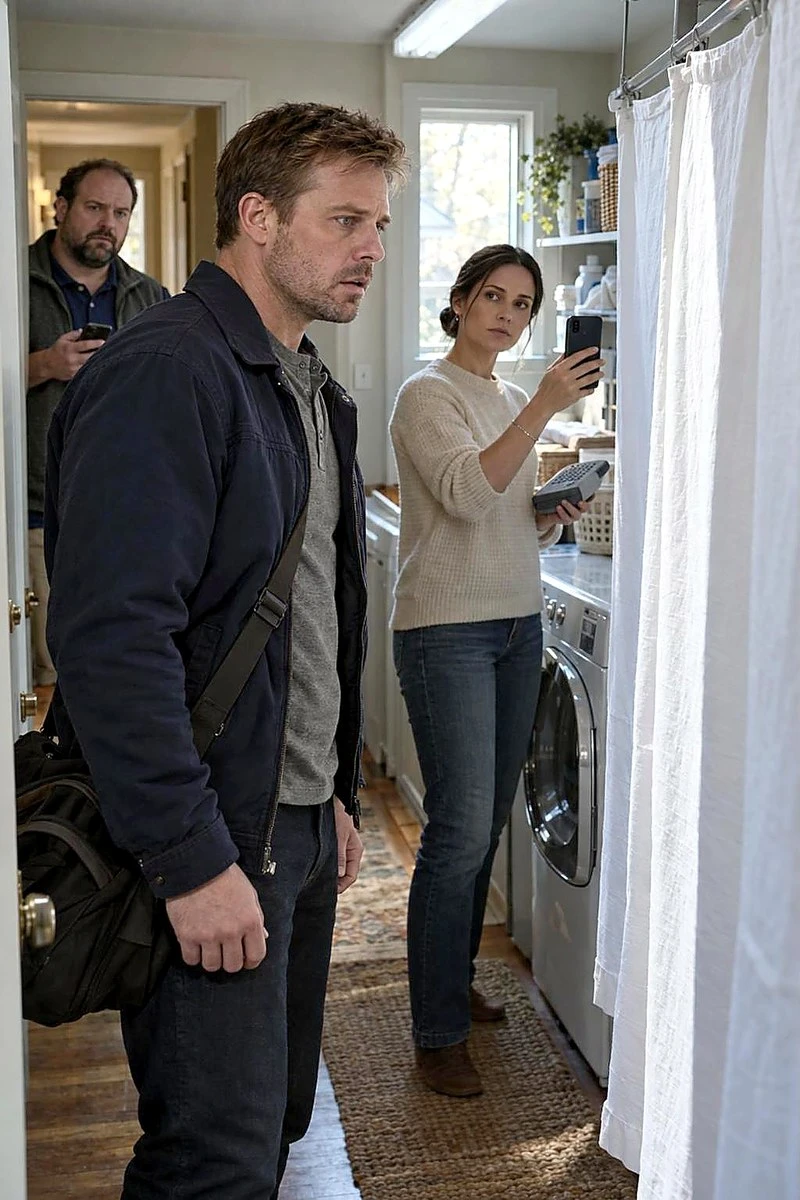
The image showed the laundry-room wall.
An edge of hanging fabric crossed the frame.
Celeste’s bracelet moved through the foreground.
Then came the clicks.
I recognized them before the cutter snapped.
“These are the words you say to Dad,” Celeste said in the recording. “You stay until we get them right.”
Avery paused.
My hand had closed around the edge of the chair.
“Is that enough for now?” she asked.
“Keep going,” I replied.
Avery advanced to another verified section.
Russell’s work jacket entered the edge of the frame.
“He’s out until Friday,” Russell said in the recording. “I handled the schedule. Tell them he agreed.”
Celeste’s hand passed over the phone.
Avery stopped the playback again.
I looked at the dark screen.
My brother had known where I would be.
My wife had known what the children would say when I returned.
I had called the result a good night.
“The phone kept recording?” I asked.
“Yes,” Avery replied. “In this file, it was moved from the laundry room to the living room. The later section contains the school-project update.”
“The one she sent me,” I said.
“The received file matches that section,” Avery replied.
I looked toward Bell.
“Their words came afterward,” I said.
“Yes,” Bell replied.
Avery closed the image.
“We’ve compared identifiers, file contents, upload records, and the corresponding exports,” she said. “The relevant sections are consistent with a continuous recording.”
“Could the date be wrong?” I asked.
“A date field by itself can be misleading,” Avery replied. “That’s why we compared it with the account records, transmissions, and your received messages.”
“What can you prove?” I asked.
“That these exports contain sections of the longer files,” Avery said. “That the preceding instructions were omitted. That the verified recordings align with other dated records.”
“Did the longer files contain their later statements?” I asked.
“Yes,” Avery replied. “The statements in the exports occur in the sources.”
“So those words weren’t invented,” I said.
“No,” Avery replied. “They were selected from a longer sequence.”
I looked at the closed laptop.
“People watched them and thought they knew what happened,” I said.
“The source lets the court examine what preceded them,” Avery replied. “It doesn’t ask the children to explain why a selected section looked reassuring.”
“And what can’t you prove?” I asked.
“What happened outside the recordings,” Avery replied. “They don’t document every day in the notebook.”
Bell opened the school-record folder.
“They corroborate an existing body of evidence,” he said. “They don’t replace it.”
I loosened my hand from the chair.
“Do the children have to watch this?” I asked.
“No,” Bell replied.
“Do they have to say it again?” I asked.
“The next steps are being coordinated without making them repeat these recordings for us,” Bell said.
Avery moved the laptop away.
I kept looking at the empty place where it had been.
* * *
At the custody hearing, Nina placed the verified source records beside the notebook, messages, and school documentation.
The children were with Cora.
They weren’t waiting in the corridor.
Celeste sat across the room.
Her thumb moved over the red cartridge on her bracelet.
Avery explained the relationship between the files.
“The submitted exports began later,” she told the court. “The source recordings preserved the preparation and instructions.”
Celeste’s attorney asked whether a longer recording necessarily proved abuse.
“No,” Avery replied. “My work establishes the files’ relationship and integrity. The conduct shown must be assessed with the other evidence.”
He asked whether the recordings covered the entire period alleged.
“No,” Avery said.
Nina turned to the corresponding dates.
“Do the verified portions align with these transmissions and notebook references?” Nina asked.
“Yes,” Avery replied.
The necessary excerpts played.
Brief.
Plain.
Adult voices.
The clicks.
I watched Celeste’s hand stop moving.
Bell explained the preserved messages and dispatch changes. The school records established concerns before my return. The independent assessment addressed the children’s needs and my current care arrangements.
Then I answered questions.
“You heard your daughter’s earlier request about the machine?” Celeste’s attorney asked.
“Yes,” I replied.
“You didn’t investigate?” he asked.
“No,” I said.
“And you told your wife you trusted her?” he asked.
“Yes,” I replied.
Nina kept her hand beside her notes.
I didn’t look at her for an easier answer.
“What did you believe you were addressing?” the attorney asked.
“Bedtime,” I said. “That was what Celeste asked me to support.”
“You were comfortable leaving her responsible?” he asked.
“I left her responsible,” I replied. “I failed to ask questions I should have asked.”
The attorney turned a page.
“And you raised your voice during the discovery?” he asked.
“Yes,” I said.
Nina later asked about the complete exchange and the steps I took after coming home.
“I called for help,” I said. “I brought both children outside and stayed with them.”
“What did you do with the card?” Nina asked.
“Gave it to the responding officer when he asked to preserve it,” I replied.
“And your work?” Nina asked.
“I stopped the overnight travel,” I said. “I changed the scheduling arrangements and kept the care appointments.”
“During the temporary supervision of your contact?” Nina asked.
“I attended every scheduled visit,” I replied. “I didn’t ask the children to give me statements for the case.”
None of it erased the earlier answers.
But the earlier answers did not turn Celeste’s recorded instructions into mine.
Nina returned to the complete message exchange.
“Did your reply mention the laundry room?” she asked.
“No,” I replied.
“Did it instruct the children to remain behind sheets?” Nina asked.
“No,” I said.
“What did it actually say after the words in the export?” Nina asked.
“That bedtime didn’t change because I was away,” I replied. “That I’d call in the morning.”
“And what should you have done with June’s request?” Nina asked.
“Asked her why she wanted the machine put away,” I said. “Listened to the rest and followed up. I didn’t do that.”
Nina left the complete exchange before the court.
When Celeste spoke, she called the clips examples of practice.
“I was trying to help them settle,” she said.
The judge looked toward the notebook exhibits.
“And the instruction that they remain until the words were right?” the judge asked.
Celeste touched her bracelet.
“It was poorly phrased,” she replied.
“And the representation that their father had agreed?” the judge asked.
“We both expected them to listen,” Celeste said.
I kept my hands on my knees.
The judge turned to the verified message exchange.
The page stayed open.
“The children will reside with their father under the protective plan,” the judge said. “Temporary supervision of his contact will end.”
“Maternal contact remains subject to review and professional supervision,” the judge continued. “Russell Shaw will have no access to the children.”
Nina put the written order in my hands outside the courtroom.
“Read the conditions,” she told me.
I read every page.
“Can I go to Cora’s tonight?” I asked.
“Yes,” Nina replied. “Follow the transition arrangements.”
“And stay?” I asked.
“Yes,” she said.
I sat on the corridor bench.
Nina stayed beside me.
I read the same sentence again.
Then I called Cora.
“The order changed,” I told her.
Cora went quiet.
“What changes tonight?” she asked.
“I can stay,” I replied.
“Then come,” Cora said. “We’ll explain it together.”
“Don’t tell them I won,” I said.
“I wasn’t going to,” Cora replied.
“I mean, don’t make them feel they have to be happy right away,” I said.
“They can come to dinner however they feel,” Cora told me. “What do they need to know first?”
“That I’m staying,” I replied.
“Then that’s where we start,” Cora said.
I looked at the order on my knees.
“I still have to collect my bag,” I told her.
“We’ll be here,” Cora replied.
* * *
June stood on the stairs when I entered Cora’s house.
Micah waited behind her.
My bag hung from my shoulder.
June looked at it first.
“Are you sleeping here?” she asked.
“Yes,” I told her.
“For tonight?” June asked.
“Yes,” I said. “And we have a plan for the days after tonight.”
Micah squeezed past her.
I put the bag down before he reached me.
June stayed on the stair.
“Do we have to tell anybody anything?” she asked.
“Not to make me stay,” I told her.
Cora moved a chair away from the kitchen doorway.
“Dinner’s ready,” she said.
June came down one step.
Then another.
At the table, Micah asked whether I could pass the peas.
June asked for the serving spoon.
I passed both.
That night, she placed the blue house beside my charger.
I set my phone down.
“Company?” I asked.
June nodded.
I stayed in the chair beside her bed.
The order had brought me back.
She still needed to find out what that meant.
* * *
The criminal proceedings took longer.
There were additional reviews, witnesses, motions, and days when an expected date moved.
Nina handled the family orders.
The prosecutor handling the criminal cases spoke with me separately.
“The recordings are part of the evidence,” she told me. “So are the messages, notebook, records, and documented accounts.”
“Will the children have to attend?” I asked.
“We’re working through the evidence and arrangements without assuming they must,” she replied. “You’ll be informed about anything that affects them.”
“What if I’m asked why I didn’t know sooner?” I asked the prosecutor.
“Answer truthfully,” she replied. “Tell us what you knew and what you failed to ask.”
“I don’t want my failure used to make hers ordinary,” I said.
“Your account is one part of the evidence,” the prosecutor replied. “The records address deliberate conduct and concealment. We won’t ask you to describe yourself as a perfect parent.”
“I couldn’t,” I said.
“Then don’t,” she replied.
I kept the children’s appointments on one calendar.
The court dates went on another.
By the time the cases reached their conclusions, June had turned nine.
Micah was six.
We had moved into a small rental house with bedrooms along the same hall.
Cora still came for dinner.
The blue house moved between a bedside table and the kitchen counter.
It was never placed in a display case.
The recordings remained in evidence.
So did the label maker.
The bracelet and red cartridge were later preserved among the physical exhibits.
I saw them in a photograph supplied with the case materials.
Ordinary objects.
I didn’t want them back.
Celeste was convicted of abusing the children.
At sentencing, the judge read from the findings.
“This was repeated conduct,” the judge said. “It was concealed from the children’s father. His supposed approval was used to control their response, while arrangements were made to keep him away.”
Celeste stood beside her attorney.
Her wrist was bare.
When she spoke, her voice remained controlled.
“I thought I was making the household manageable,” she said. “I understand the court sees it differently.”
The judge looked down at the findings, then back at her.
“The children’s fear was not a household-management problem,” the judge said.
I kept my eyes on the bench.
“The custodial sentence is four years,” the judge said.
The protective restrictions remained.
No one told the children that a sentence meant they should feel finished.
Russell’s case concluded separately.
His knowing assistance and role in concealing the conduct were established.
“You knew the location and the signal,” the judge told Russell. “You assisted with scheduling and concealment. The selected records you later offered must be understood beside the material you retained.”
Russell stood beside his attorney.
“The custodial sentence is eighteen months,” the judge said.
Outside that courtroom, he looked toward me.
His attorney stood beside him.
“Ethan,” Russell said.
I stopped several feet away.
“I kept the files,” he said.
“Yes,” I replied.
“You wouldn’t have had them otherwise,” Russell said.
“You kept them for yourself,” I told him.
Russell lowered his eyes.
His attorney touched his arm.
I walked toward the exit.
* * *
Meredith called after the sentencing.
“I was wrong about the picture,” she said.
I stood in our rental kitchen.
Cora was helping Micah carry plates to the table.
“The picture was real,” I told Meredith. “What you were told it proved wasn’t.”
“I should have listened,” Meredith said.
“Yes,” I replied.
“Could I speak with June?” she asked.
“Not about this,” I told her.
“I want her to know I believe her,” Meredith said.
“She doesn’t need to give you another account,” I replied.
“That isn’t what I meant,” Meredith said.
I watched June put the serving spoon beside the bowl.
“Send something ordinary,” I told Meredith. “A birthday card when it’s her birthday. Don’t ask her to settle your feelings.”
Meredith paused.
“All right,” she said.
I ended the call.
June looked toward my phone.
“Dinner?” she asked.
“Dinner,” I replied.
I put it away.
* * *
At a later appointment, Dr. Vega asked how we were managing the changes.
“They ask different questions,” I told her.
“Give me an example,” she said.
“June wants to know whether she ever has to see Celeste,” I replied. “Micah asks what her room is like.”
“What do you tell them?” Dr. Vega asked.
“That contact is reviewed and supervised,” I said. “That they can tell the adults what they want and what worries them.”
Dr. Vega nodded.
“And when Micah asks about her room?” she asked.
“I answer what I know,” I replied. “I don’t ask him why he wants to know.”
“Good,” she said.
“Do they need the same answer about contact?” I asked.
“They need accurate information about the safeguards,” Dr. Vega replied. “Their feelings and wishes can be different.”
“What if one wants to talk and the other doesn’t?” I asked.
“Then we listen to each child,” she said. “We don’t ask one to decide for both.”
I looked at the two chairs beside her toy shelf.
“I keep wanting one plan that makes them both comfortable,” I admitted.
“We can make a safe plan,” Dr. Vega replied. “We can’t make their feelings match.”
“And if they change their minds?” I asked.
“Tell the adults coordinating care,” she replied. “They don’t need to defend a feeling like a verdict.”
I moved my chair closer to the table.
“June still checks whether I’m going away,” I told her.
“Keep giving her accurate information,” Dr. Vega replied.
“I want the order to be enough,” I admitted.
Dr. Vega kept her hands on the table.
“It changes what adults can do,” she said. “Trust grows in the days they live through.”
I looked at the appointment card she had given me.
The next date was written clearly.
I put it in my phone before leaving.
* * *
A few months after sentencing, a packet arrived from the contact-review coordinator.
I recognized the return address.
Requests concerning Celeste were handled through the existing process.
None came straight to the children.
I put the envelope on the counter until after dinner.
Micah was building a small bridge from craft sticks.
June was reading in the front room.
The blue house sat beside the napkin holder.
Cora had gone home.
I checked the next day’s school arrangements before opening the packet.
I expected another request from Celeste.
A proposed date.
A promise that she understood.
Something I would take to Nina and Dr. Vega.
The cover sheet referred to a request for a brief supervised visit.
An attached page was handwritten.
The letters were uneven.
I recognized them before I reached the name.
Inside the packet was a request to see Celeste—and Micah had signed it instead of her.